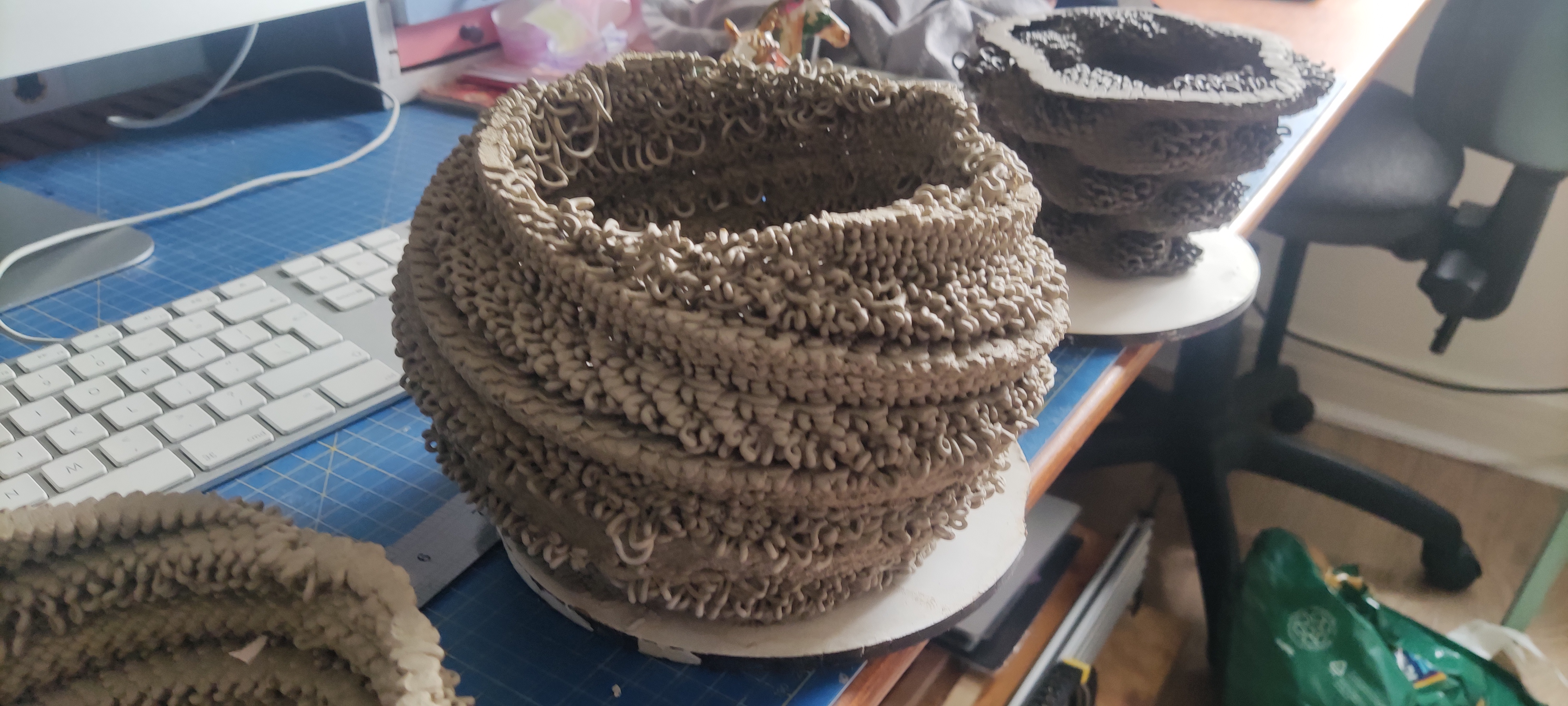
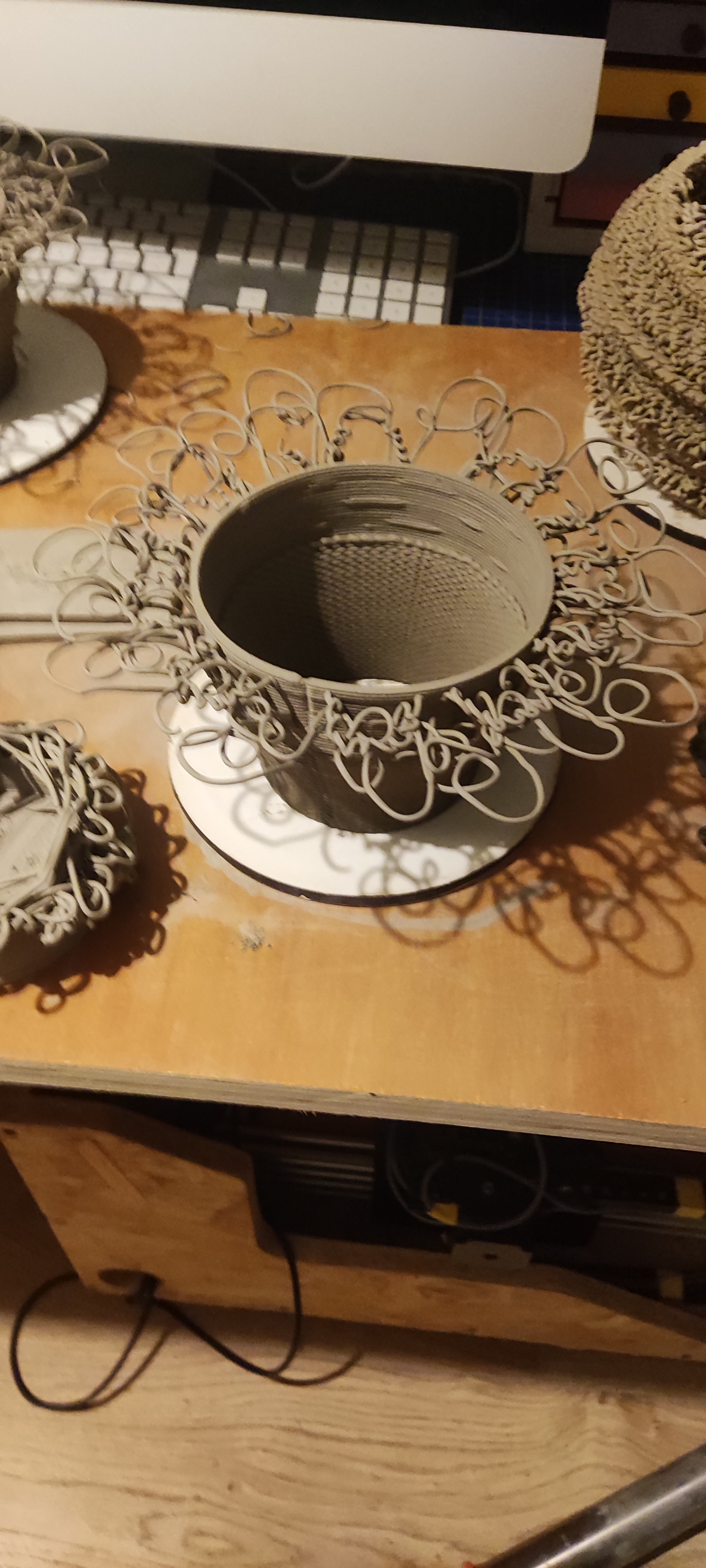
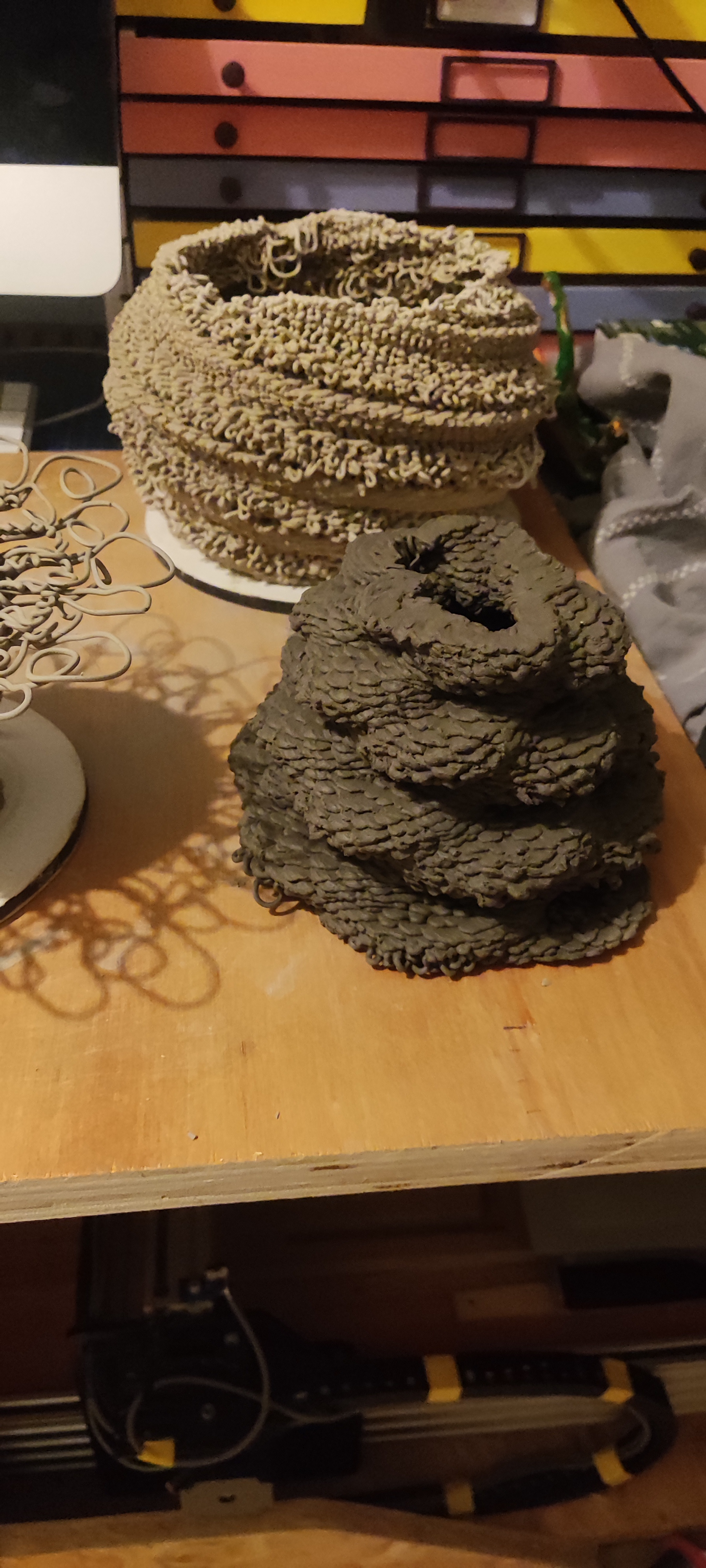
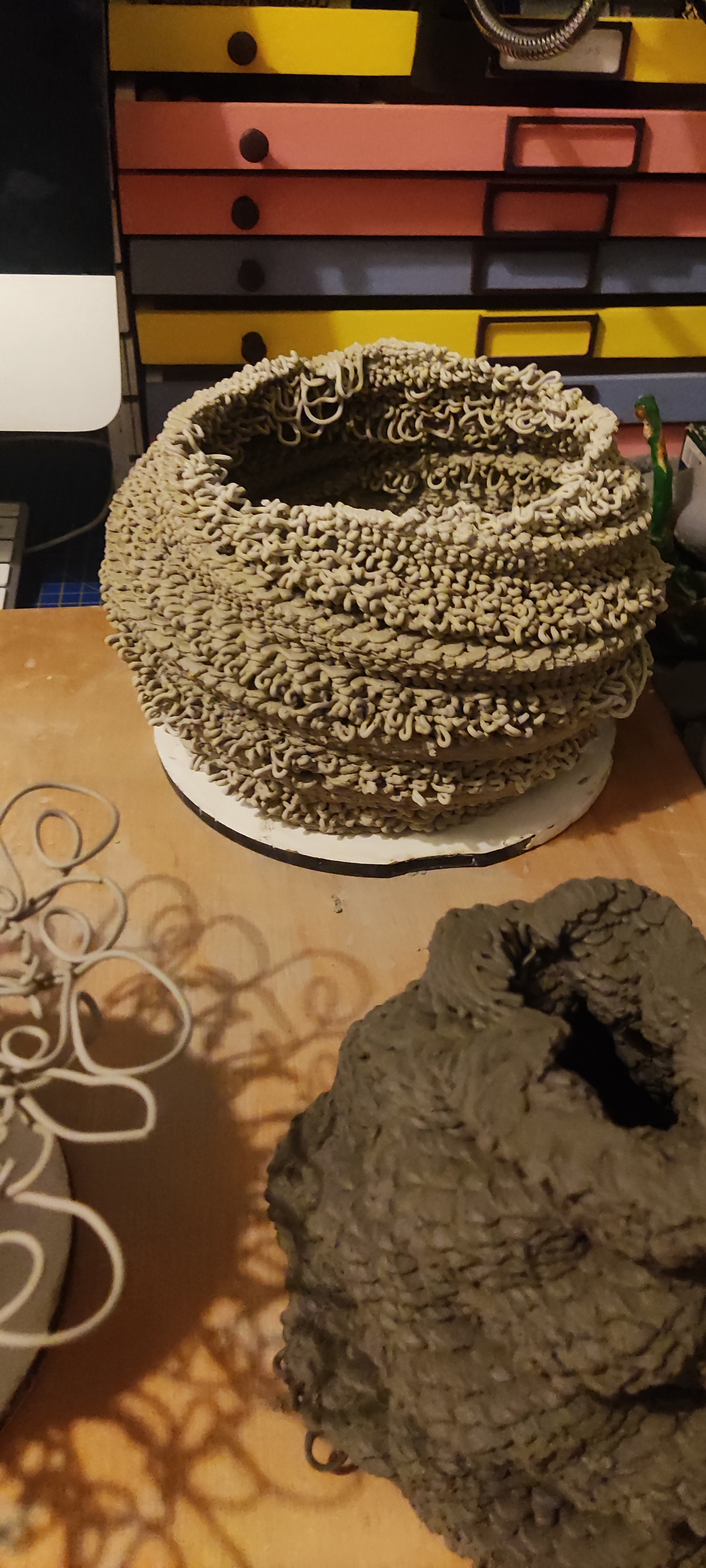
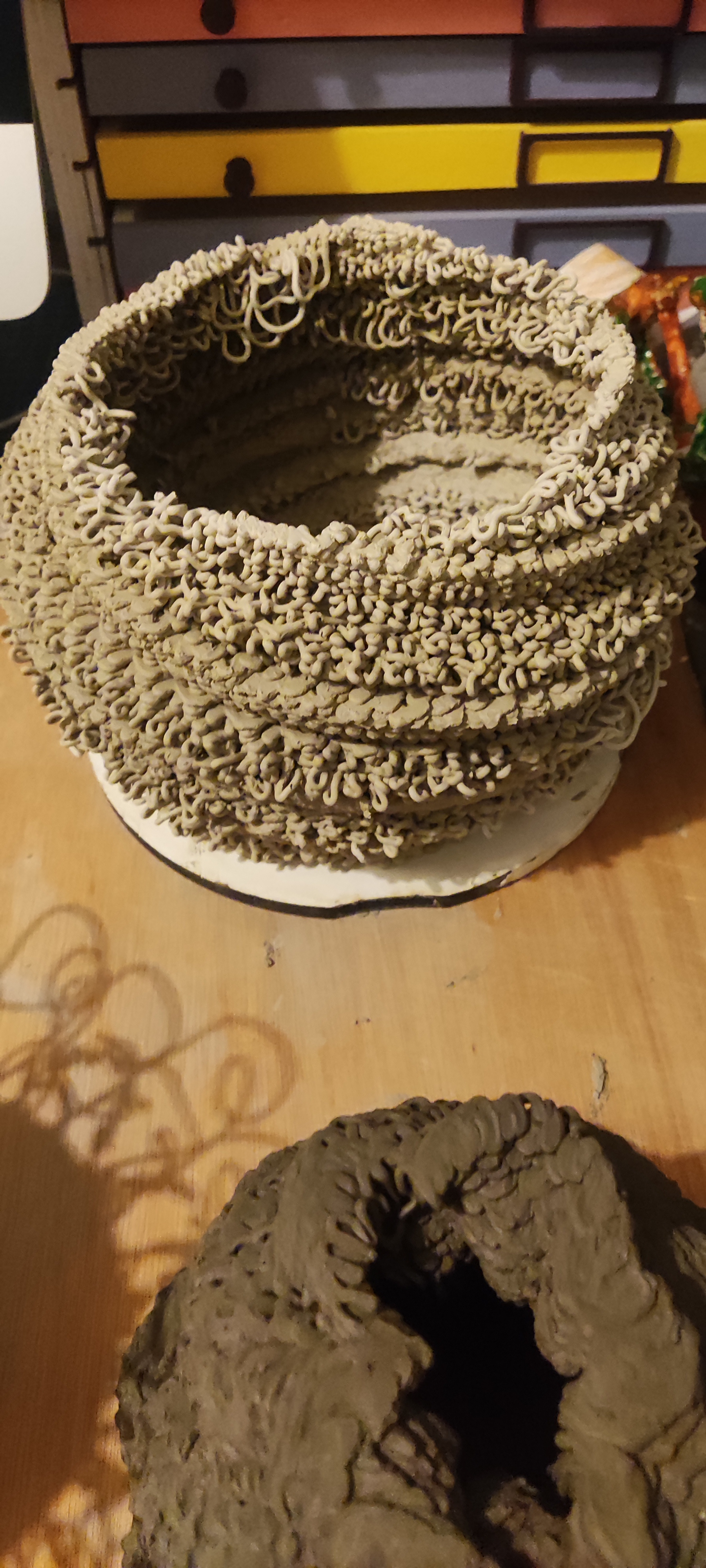
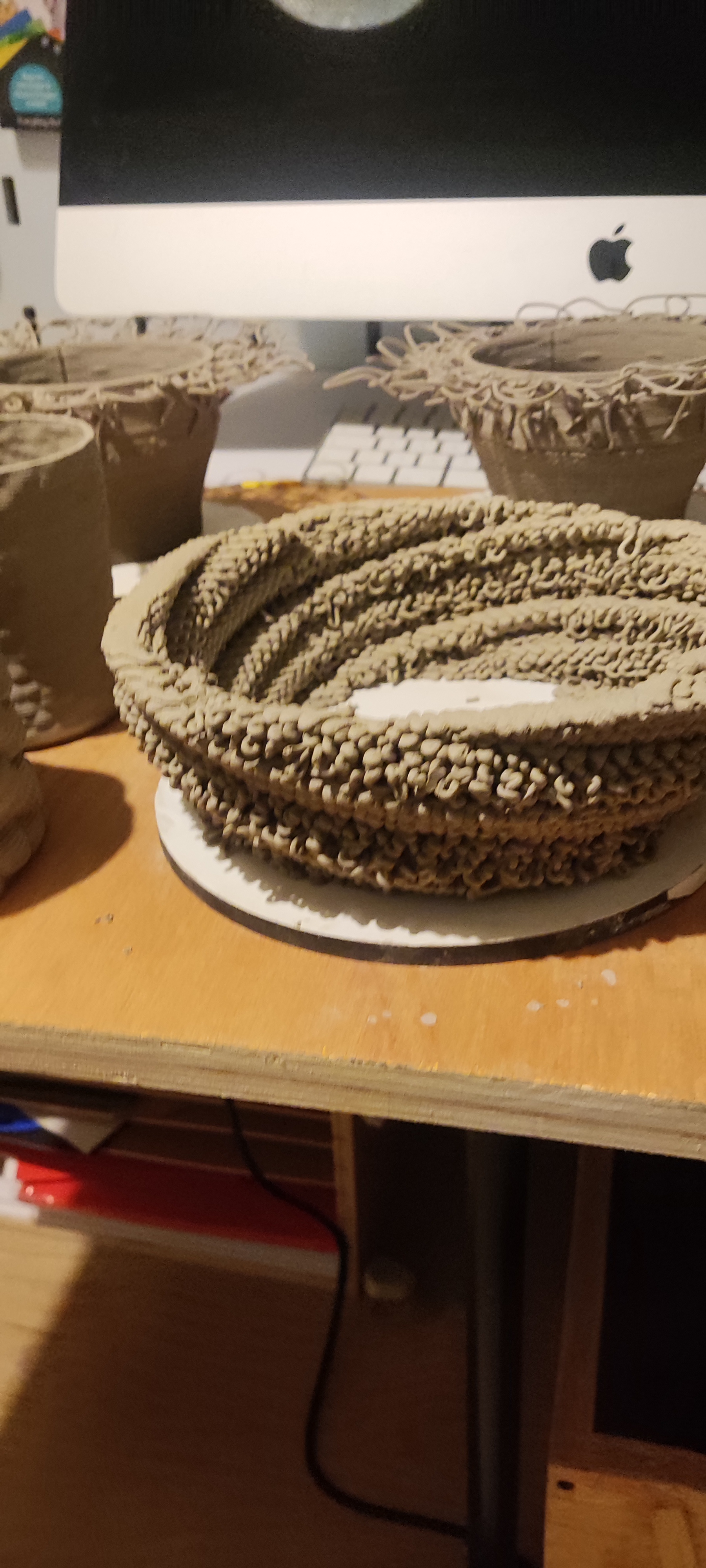
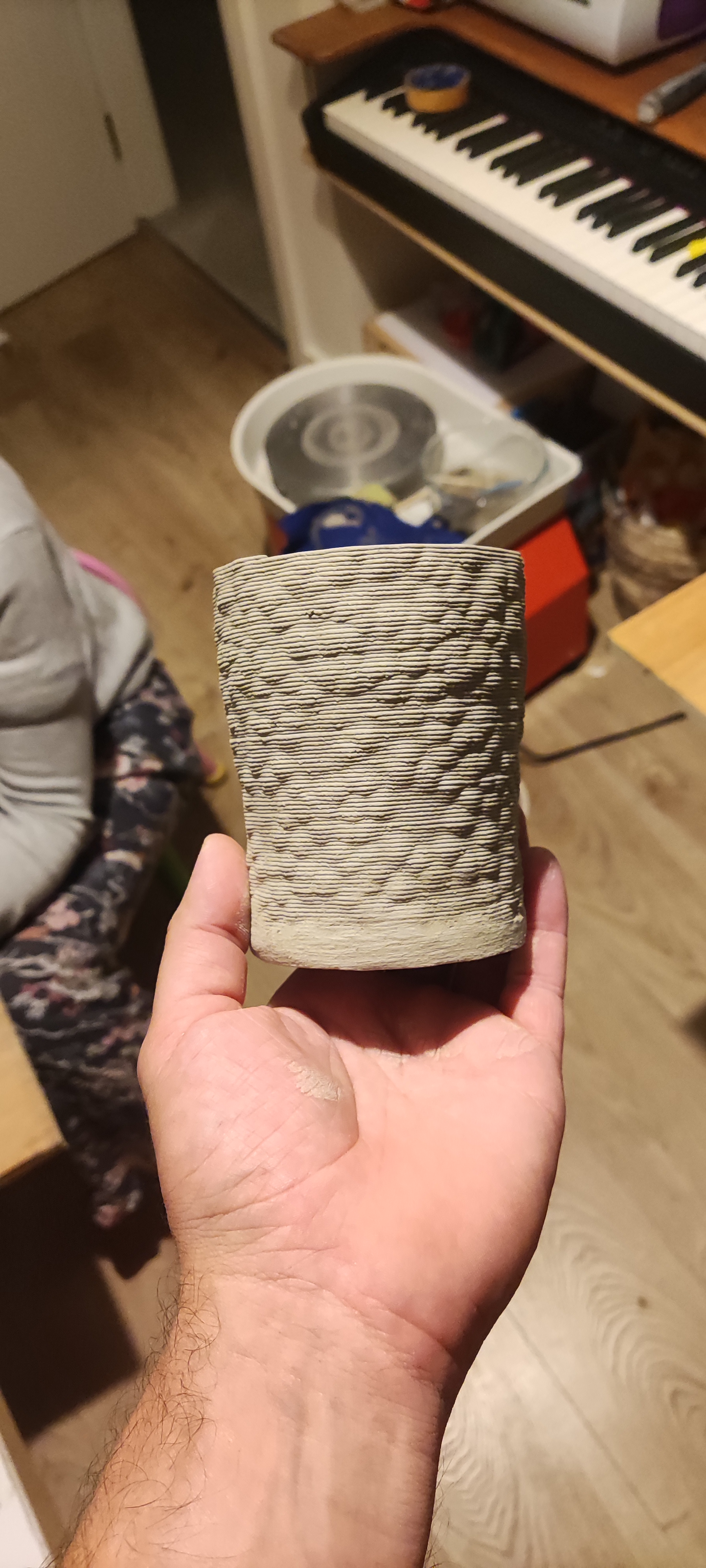
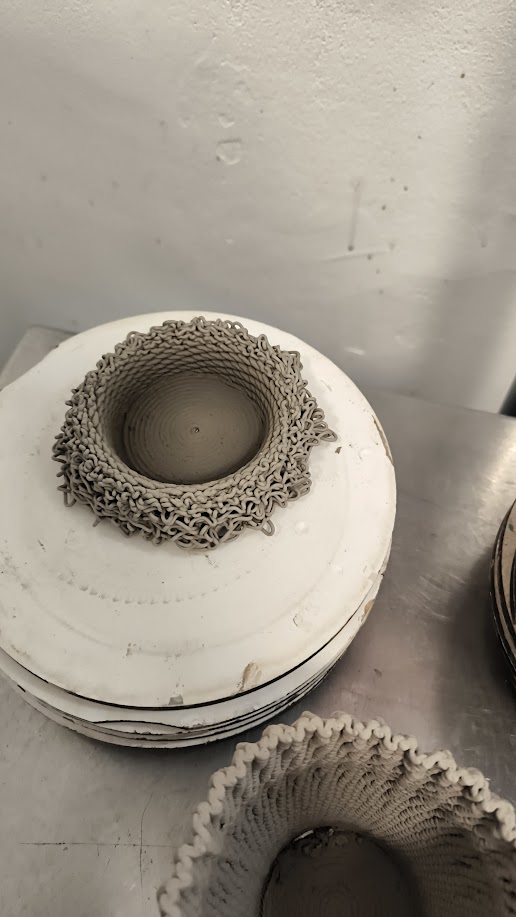
Using Python scripting inside Blender to generate the paths that define ceramic forms, then converting those paths to G-code for clay fabrication. The script gives precise control over the profile of a form and opens up surface variation that would be difficult or impossible to produce by hand.
The Approach
The starting point is a path, a curve in 3D space that the clay extruder follows as it builds up the form layer by layer. In standard clay printing this path is usually circular and flat. Writing it in Python instead of drawing it manually means it can be defined mathematically, and any function can be applied to it.
The path is generated in Blender using a Python script, then exported as G-code that the fabrication machine reads directly. The workflow is: write or modify the script, preview the path in Blender, export, print.
Pattern Types
Once the path is scripted rather than drawn, a range of mathematical functions can be applied to the profile. Some of the variations tested:
- Sine waves: a smooth oscillation along the circumference, producing a rippled surface. Frequency and amplitude are both adjustable.
- Sawtooth and triangle waves: sharper transitions that produce ridges or fins rather than smooth curves.
- Noise functions: Perlin noise and similar algorithms introduce controlled randomness. No two passes around the circumference are identical, but the overall character of the surface stays consistent.
- Combined functions: layering a sine wave with a noise offset, or running two different frequencies simultaneously, produces more complex surface behaviour.
In all cases the variation is applied to the path before fabrication, so what changes is the profile of the form itself, not a surface treatment applied afterwards.
The Blender Plugin
As the work progressed, the scripts that were being rewritten for each experiment were consolidated into a Blender plugin. The plugin exposes the key parameters directly in the interface: wave type, amplitude, frequency, noise scale, extrusion width, layer height. Changes can be previewed in the 3D viewport before committing to a print.
This made iteration significantly faster and also made it easier to document which parameter combinations produced which results.
Structural Integrity Research
The main research question is how far the path can deviate from being flat before the form loses structural integrity.
In standard clay extrusion, each layer sits level on the one below. When the path introduces vertical variation within a single layer, sections of the form are at different heights, and the clay that follows has to bridge or climb. The material has limits. Too steep a deviation and the form slumps or cracks. Too much twist and adjacent layers no longer bond properly.
The experiments have tested:
- Path twist: rotating the extrusion profile progressively along the path, so the cross-section of the clay changes orientation as it travels around the form.
- Non-planar layer deviation: raising or lowering sections of a single layer so the path is no longer flat, varying how far this can go before the structure fails.
- Variable extrusion: adjusting how much clay is extruded in different sections to compensate for geometric changes in the path, attempting to maintain consistent wall thickness even where the path deviates.
The range of permissible deviation before failure depends on the clay body, humidity, temperature, and layer height. These are being tested systematically rather than optimised for a specific result.