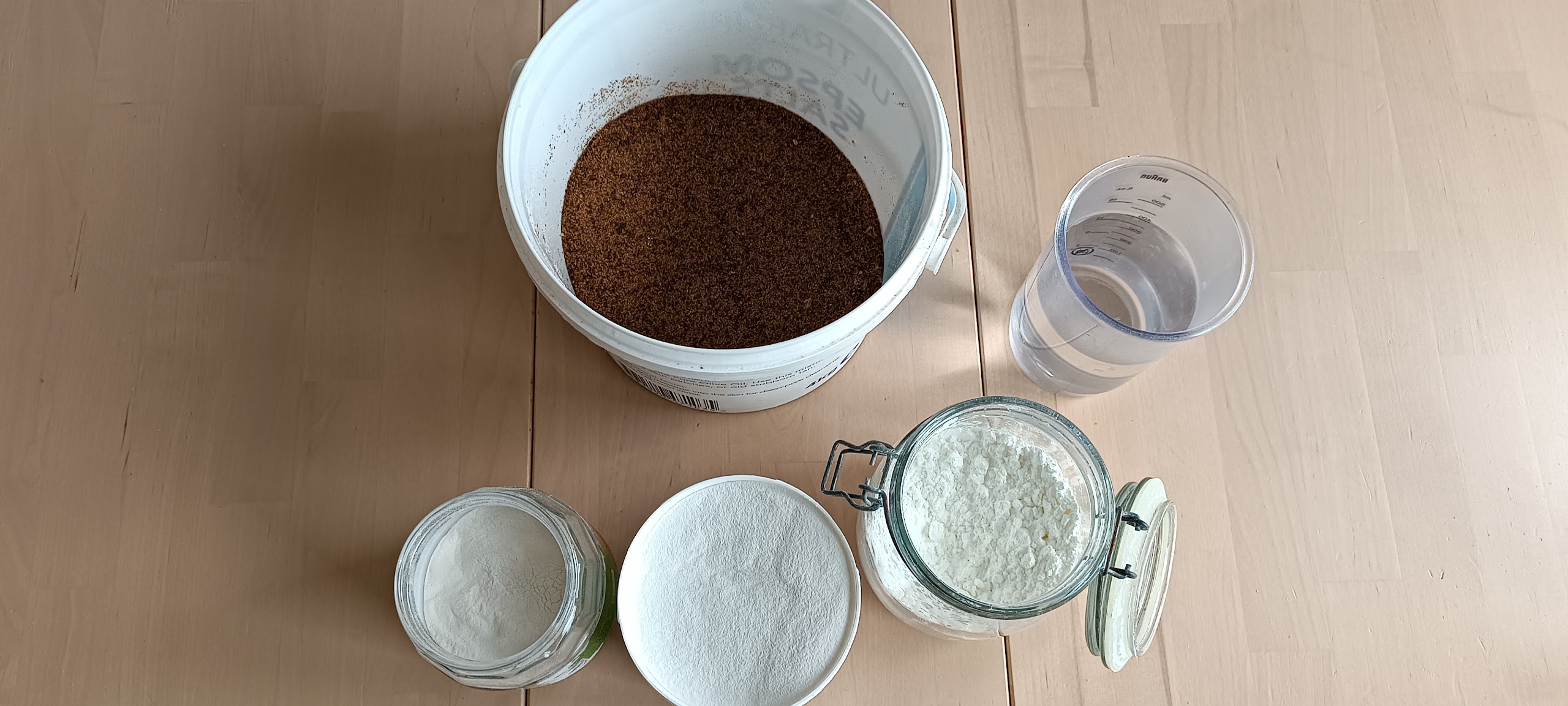
A series of material experiments testing biodegradable alternatives to clay for paste extrusion 3D printing. Starting from a 2024 ACM cookbook of sustainable biomaterial recipes, the work extended the material set with additional ingredients and evaluated which are suitable for future workshop use.
Background
Paste extrusion 3D printing, also known as Direct Ink Writing, works by extruding a paste-like material in layers rather than melting a plastic filament. Clay is the most common material for this approach, but any paste with the right rheological properties can be used.
The starting point for these experiments was: Fiona Bell, Camila Friedman-Gerlicz, and Leah Buechley. 2024. Biomaterial Recipes for 3D Printing: A Cookbook of Sustainable and Extrudable Bio-Pastes. ACM. doi:10.1145/3689050.3704427. Their cookbook presents recipes made from sawdust, orange peels, and tree leaves, alongside a framework for evaluating whether a biomaterial recipe is printable, usable, and sustainable.
The motivation here was different from theirs in one important respect: the materials were being evaluated not only as objects in themselves, but as candidates for future paste-based 3D printing workshops, where participants mix and extrude their own bio-materials rather than loading a plastic filament spool.
Materials Tested
The cookbook's sawdust recipe was tested as a reference point. Three additional materials not covered in the publication were then tested alongside it:
- Seaweed: processed into an alginate-based paste. Seaweed-derived sodium alginate is a known binder in food and biomaterial work, and it produces a gel-like consistency when hydrated that has potential for extrusion.
- Eggshell powder: ground dried eggshell mixed into a paste base. The calcium carbonate content gives it mineral properties similar to some ceramic bodies, and the material is widely available as a food-production by-product.
- Semolina flour: mixed with water to form a dough-like paste. Flour-based pastes have been used in previous biomaterial research (corn and wheat flour appear in the literature) and semolina's coarser grain size was of interest for surface texture.
Evaluation Criteria
Each material was evaluated against the three qualities introduced in the Bell et al. cookbook:
- Printability: does the paste extrude consistently without blocking the nozzle, and does it hold its shape on the print bed long enough for layers to build up?
- Usability: does the finished object dry without cracking significantly, and is it structurally sound enough to be handled?
- Sustainability: is the material derived from renewable or waste sources, and does it biodegrade or dissolve when no longer needed?
A fourth consideration was added for the workshop context: accessibility: how easy the material is to prepare, how safe to handle without specialist equipment, and how cost-effective and available the ingredients are.
Findings
The experiments were run during summer 2024 using a home paste extrusion printer setup. Not all materials performed equally across the four criteria, and the failures were as informative as the successes. Some materials that were sustainable and accessible proved difficult to extrude consistently; others extruded well but cracked significantly during drying.
The results fed directly into later material development work, informing which bio-paste candidates are viable for workshop use and which need further recipe development before they can be reliably handed to a group of participants with limited preparation time.